

Aerial bundle cable is an increasingly adopted distribution technology that reduces common overhead failure modes by enclosing phase conductors in insulated sheaths and bundling them closely together. By changing how conductors interact with vegetation, animals, and human interference, aerial bundled cable shifts fault patterns from frequent, transient outages toward fewer, more manageable incidents.
Utilities deploy it to improve reliability, lower non-technical losses, and simplify maintenance in dense urban and peri-urban networks. The benefits are tangible: fewer phase-to-phase and phase-to-ground faults, reduced flicker and fewer customer minutes lost, and a measurable decrease in theft-related energy losses where illegal tapping has been prevalent.
Successful adoption depends on careful specification, feeder-level analysis, and lifecycle planning. Not all ABC systems perform equally; metallic screening, insulation material, and proper jointing practice determine whether aerial bundle cable reduces ignition risk and long-term faults or introduces new failure modes.
Case studies from utilities and peer-reviewed simulations show that when ABC is paired with targeted feeder prioritization, crew training, and ongoing condition monitoring, it delivers strong returns on resilience and revenue protection.
We will cover metrics such as faults per kilometer, customer minutes lost, theft indicators, and lifecycle costs so decision-makers can quantify benefits and prioritize interventions with confidence in real-world settings.
This introduction frames how ABC works, the engineering and operational trade-offs, and why a disciplined implementation is essential to capture benefits without raising new risks. Read on for practical steps, evidence from real projects, and actionable guidance for planners and field teams.
Aerial Bundle Cable Impact on Fault Reduction and Long Term System Resilience
Aerial bundle cable (ABC) is an overhead distribution system in which insulated phase conductors are grouped together and supported as a single assembly. ABC typically combines two or three phase conductors, plus a neutral or messenger, inside insulated sheaths. The construction reduces exposed live metal and changes how the line behaves when it contacts vegetation, animals, or human interference.
Core components
- Insulated phase conductors: individual cores with polymer insulation.
- Neutral/messenger: bare or insulated conductor for mechanical support and return path.
- Outer sheath (optional): protective jacket for environmental resistance.
- Connectors and joints: specially designed for insulated conductors.
Key design variants
- Low-voltage aerial bundle cable for distribution (commonly used in urban areas).
- Medium-/high-voltage ABC with metallic screening or armoring for improved fault and surge control.
- Service-drop ABC for last-meter connections to customers.
Primary functions
- Prevent direct phase-to-phase and phase-to-ground flashovers from light contact.
- Reduce opportunities for illegal tapping and non-technical losses.
- Simplify lineside vegetation management compared with bare conductors.
When ABC is chosen
- Dense urban or peri-urban feeders with many trees or unauthorized connections.
- Areas where undergrounding is too costly but reliability improvements are needed.
- Projects targeting rapid revenue protection or reduced outage frequency.
Quick technical notes
- ABC imposes different mechanical loads and requires compatible poles and fittings.
- Installation and jointing follow specific procedures; crews need training.
This primer establishes what ABC is, its parts, and the contexts where it is commonly specified.
How ABC Cuts Faults – The Mechanisms
Aerial bundle cable reduces faults through physical insulation, altered electrical pathways, and restricted access. Below are the specific mechanisms and the operational consequences utilities should expect.
Physical insulation
- Insulated phase conductors block direct electrical contact with vegetation and animals.
- Result: fewer phase-to-phase and phase-to-ground short circuits from light brush or bird landings.
Bundling geometry
- Phases are held close, which reduces the chance of conductor sway causing phase-to-phase contacts.
- Reduced span-induced oscillation lowers transient clashing faults.
Reduced arcing and tracking
- Insulation prevents immediate arcing on light contacts; partial discharges are less likely to escalate into full faults.
- For exposed pollution-prone environments, insulation selection limits surface tracking.
Tamper resistance
- Insulation and tougher sheath materials increase the effort required for illegal tapping and meter bypass.
- Reduced non-technical losses translate into fewer service disruptions caused by ad-hoc repairs.
Improved fault behavior
- Metallic-screened aerial bundle cable confines electromagnetic fields and provides defined paths for fault currents and surges.
- Grounding and screening design determines whether a fault is isolated or becomes system-wide.
Operational consequences
- Fewer transient, momentary interruptions (flicker events).
- Lower frequency of emergency repairs driven by animal or vegetation contact.
- Shifts maintenance from reactive vegetation clearance to scheduled inspections for insulation wear.
Limitations of mechanisms
- Heavy contact or severe abrasion can still damage insulation.
- Poorly specified ABC may introduce other failure modes (tracking, sheath damage) if environmental factors are not considered.
These mechanisms combine to change fault patterns from frequent random events to fewer, more diagnosable incidents, improving network availability when implemented correctly.
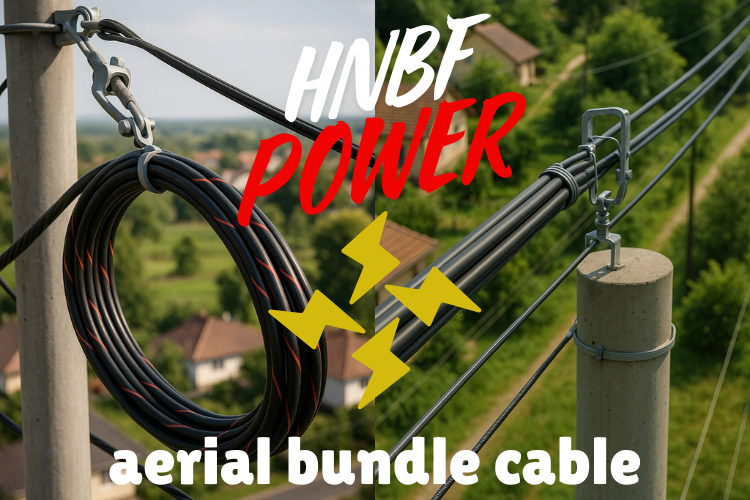
Evidence From The Field – Concrete
Utilities and grid analyses consistently report that aerial bundle cable changes outage drivers and measurable reliability metrics. The evidence is based on fault logs, outage minutes, customer interruption reports, and revenue metrics collected before and after ABC deployment across many feeders and environments.
Observed quantitative effects
- Reduced vegetation-related faults: Networks that replaced bare conductors with ABC generally record a drop in faults attributed to tree contact.
- Lower animal-related incidents: Bird and small-animal induced short circuits are less frequent on insulated conductors.
- Shorter outage restoration times: Insulated conductors often allow simpler diagnostics and targeted repairs, reducing average repair time.
Common measured indicators
- Faults per kilometer per year: decreases where vegetation was a dominant cause.
- Customer minutes lost (CML): reduced on feeders that show significant contact-related events.
- Recorded theft incidents and tamper repairs: decline in areas where illegal tapping was common.
Patterns by environment
- Dense urban feeders: effectiveness is high because many faults originate from close-proximity contacts and illegal connections.
- Peri-urban/rural with heavy tree cover: improvements depend on tree types and contact severity; aerial bundle cable reduces light-contact faults but not severe storm damage.
- Polluted/coastal areas: insulation selection affects outcomes; surface tracking can offset some gains if unsuitable materials are used.
Measurement caveats
- Baseline data quality matters; accurate pre-implementation logs are required to quantify benefit.
- Performance gains are context-specific networks with low vegetation faults see smaller reliability changes.
- Economic benefits (reduced losses, improved revenue) are realized where non-technical losses were a significant issue.
Field evidence supports ABC as an effective reliability tool when selected and applied to feeders where contact and tampering are leading fault causes.
Evidence Synthesis – What the Data Shows
When multiple installations and monitoring programs are compared, the data coalesces into clear patterns. The synthesis below summarizes the typical outcomes, dependencies, and metrics utilities should expect.
Consistent outcomes
- Fault frequency reduction is most pronounced for vegetation and animal-initiated events.
- Improved supply continuity measured as fewer momentary interruptions and lower customer minutes lost.
- Revenue protection where illegal tapping was high, with decreased incidence of tampering-related outages.
Key dependencies
- Initial fault mix: ABC delivers the largest benefit where contact-based faults dominate.
- Specification quality: Material properties, metallic screening, and sheath robustness materially affect lifecycle performance.
- Maintenance regime: Gains are maximized when ABC is supported by condition monitoring and planned replacement cycles.
Quantitative indicators to monitor
- Change in faults/km/year (pre vs post).
- Percent reduction in vegetation- and animal-related events.
- Change in average time to repair (minutes).
- Metered energy recovery and reduction in non-technical loss percentage.
Trade-offs highlighted by data
- Capex vs opex: Higher initial cable costs can be offset by fewer fault repairs and recovered revenue, but payback depends on local loss factors.
- Weight and civil cost impacts: Stronger poles or shorter spans can increase civil works, impacting overall ROI.
- Aging effects: Without lifecycle planning, insulation degradation can lead to late-stage failures that offset early benefits.
Actionable synthesis
- Prioritize feeders using a simple decision rule: high contact-fault share OR high non-technical loss → strong ABC candidate.
- Combine aerial bundle cable with a metrics program that tracks the four quantitative indicators above to validate outcomes and adjust rollout.
The data synthesis shows ABC is effective under defined conditions and that monitoring and specification are essential for sustained benefit.
Practical Implementation Checklist for Durable Fault Reduction
This checklist provides action-oriented steps to plan, procure, install, and operate ABC for measurable fault reduction. Use it as a working template to align technical teams, procurement, and field crews.
Pre-implementation
- Baseline data capture: collect 12–24 months of fault logs, outage minutes, and theft indicators.
- Feeder scoring: rank feeders by vegetation-fault share, theft rate, and customer criticality.
- Economic modelling: run simple ROI cases including capex, reduced fault cost, and recovered revenue.
Specification and procurement
- Choose insulation and sheath rated for local UV, pollution, and salt exposure.
- For medium/high voltage, select metallic-screened aerial bundle cable where surge behavior and grounding matter.
- Include jointing kits, poles, and hardware in procurement bundles to ensure compatibility.
Training and tooling
- Train crews in ABC handling, jointing, and tensioning techniques.
- Procure specialized tools (winches, clamps, insulated joints) and spare parts inventory.
Installation best practices
- Follow torque and tension specs; avoid over-tension that can abrade sheaths.
- Use dedicated hardware to prevent sheath contact points.
- Document each installation with photos and serial numbers for traceability.
Operations and maintenance
- Schedule inspections focusing on abrasion points, sheath discoloration, and joints.
- Implement condition monitoring (thermographic checks, visual inspections).
- Maintain spare-part stocks and a rapid-response crew for damage events.
Performance tracking
- Define KPIs: faults/km/year, CML, average repair time, non-technical loss %.
- Set quarterly reviews and adapt rollout priorities based on KPI performance.
Risk controls
- Include replacement windows in asset plans.
- Budget for additional pole strengthening where spans increase loads.
This checklist turns planning into executable tasks and keeps focus on the operational changes needed to lock in ABC benefits.
Known Drawbacks and How to Manage them
ABC brings new technical and operational considerations. Below are the main drawbacks and clear mitigation steps to manage risks and preserve reliability gains.
Drawback: Higher initial cost
- Impact: Material and installation cost higher than bare conductors.
- Mitigation: Use feeder-level ROI; prioritize where benefits (reduced faults, recovered revenue) exceed incremental capital.
Drawback: Increased mechanical load
- Impact: Heavier cable can require pole strengthening and different span design.
- Mitigation: Survey pole strength and plan civil reinforcement or reduced span length in procurement specs.
Drawback: Insulation aging and tracking
- Impact: UV exposure, pollution, and abrasion can degrade insulation, causing late-life faults.
- Mitigation: Specify UV-resistant compounds, perform regular inspections, and schedule replacement windows.
Drawback: Repair complexity
- Impact: Joints and damaged sheaths may need specialized repair techniques and insulated joint kits.
- Mitigation: Stock joint kits, train crews on insulated repair methods, and deploy mobile-equipped teams.
Drawback: Potential for hidden defects
- Impact: Internal damage or partial discharge may not be visible until failure.
- Mitigation: Use periodic diagnostic testing (partial discharge testing, thermography) and include sample destructive testing on spares.
Drawback: Storm and extreme mechanical events
- Impact: Severe storm damage can still cause outages; heavier loads can affect pole collapse risk.
- Mitigation: Combine aerial bundle cable with pole design standards, guying strategies, and targeted undergrounding in highest-risk corridors.
Drawback: Supply chain and quality risk
- Impact: Poor-quality ABC can fail early.
- Mitigation: Pre-qualify suppliers, require material test certificates, and include warranty and acceptance testing clauses.
Operational governance
- Establish clear maintenance contracts, KPI-linked performance targets, and an asset lifecycle plan to manage these drawbacks systematically.
Managing drawbacks requires upfront design attention and an enduring maintenance discipline to ensure ABC is a net reliability gain.
Short Implementation Playbook (first 12 months)
This step-by-step playbook breaks the first year into actionable windows with measurable deliverables for a focused ABC rollout pilot and early expansion.
Month 0–2: Prepare and measure
- Deliverable: baseline dataset compiled (fault logs, CML, theft incidents).
- Actions: identify 4–6 candidate feeders; run simple ROI models.
- KPI: feeders ranked and pilot selected.
Month 2–4: Finalize specs and procure
- Deliverable: approved technical specification and procurement package.
- Actions: choose insulation type, metallic screening if needed, procure joint kits and poles.
- KPI: contracts placed and delivery timelines set.
Month 4–6: Pilot installation
- Deliverable: pilot installation completed on 2–3 feeder sections.
- Actions: train crews, install with documentation, record installation metrics.
- KPI: pilot installation quality sign-off and photo log.
Month 6–9: Monitor and evaluate
- Deliverable: 3 months of post-installation KPI collection (faults, CML, theft indicators).
- Actions: compare against baseline, inspect joints and sheath conditions.
- KPI: percent change in faults and average repair time.
Month 9–12: Refine and scale plan
- Deliverable: rollout plan for next tranche based on pilot performance.
- Actions: adjust specs, training, spares inventory, and procurement volumes.
- KPI: go/no-go decision for scale-up and initial budget allocation.
Governance and reporting
- Monthly operations review during pilot.
- Quarterly executive summary including KPI trends and financial impact.
Risk controls
- Maintain contingency budget for unexpected pole upgrades.
- Keep spare crews and parts for rapid remediation.
This 12-month playbook focuses on measurable pilots, learning, and controlled scale-up to ensure ABC delivers predictable reliability gains.
Final Takeaway and Conclusion
Aerial bundle cable is a targeted intervention that shifts common overhead fault drivers through insulation, bundling, and design choices. When feeders suffer frequent vegetation contact, animal interference, or high non-technical losses, ABC provides measurable reductions in fault frequency and in customer interruption minutes. The technology is not a universal solution: outcomes depend on feeder selection, technical specification, and lifecycle management.
Summarized best-practice checklist
- Prioritize feeders where contact and tampering dominate fault causes.
- Specify materials for environment and include metallic screening where fault behavior requires it.
- Train crews, procure compatible hardware, and maintain spares.
- Implement condition monitoring and define replacement windows.
- Track KPIs: faults/km/year, customer minutes lost, average repair time, and percent non-technical loss.
Operational mindset
- Treat ABC as part of an integrated resilience program: combine data-driven feeder selection, measured pilots, and disciplined maintenance.
- Expect early reliability gains but plan for mid- to long-term lifecycle costs and inspections.
Closing line
When implemented with clear selection criteria, correct specification, and ongoing maintenance discipline, aerial bundle cable becomes an effective tool for reducing faults and improving long-term system resilience.