

AAC conductor material plays a critical role in modern power transmission and distribution systems, providing a reliable, cost-effective, and efficient solution for carrying electricity over short and medium distances. As utilities and EPC contractors design and implement electrical networks, understanding the characteristics and performance of AAC conductors is essential for ensuring safety, efficiency, and longevity.
AAC, which stands for All Aluminum Conductor, is composed entirely of high-purity aluminum strands, offering excellent electrical conductivity, natural corrosion resistance, and ease of installation due to its lightweight nature. Compared to other conductor types, such as ACSR (Aluminum Conductor Steel Reinforced), AAC is particularly suitable for low-voltage distribution lines, urban electrification projects, and rural power networks where tensile strength requirements are moderate.
Its compliance with international standards like IEC 61089 and ASTM B230 ensures that projects meet regulatory and operational requirements, providing engineers and project planners confidence in material quality. As the demand for efficient and reliable electrical networks grows globally, selecting the right conductor material becomes a decisive factor in project success.
AAC Conductor Material vs ACSR: Choosing the Right Conductor for Your Project
Selecting the right conductor is a crucial decision for any electrical transmission or distribution project. Conductors determine not only the efficiency and reliability of power delivery but also impact cost, maintenance, and long-term performance.
Two of the most commonly used overhead conductors in the industry are AAC (All Aluminum Conductor) material and ACSR (Aluminum Conductor Steel Reinforced). Understanding the differences between these conductors, their applications, and performance characteristics is essential for engineers, utilities, and EPC contractors.
In this guide, we will explain how to choose between AAC and ACSR conductors for your project.
1. Introduction
Overhead conductors form the backbone of power transmission and distribution networks. These conductors must meet specific standards for electrical conductivity, mechanical strength, and durability, while also being cost-effective.
Choosing between AAC conductor material and ACSR conductors is not merely a technical preference; it depends on project-specific requirements such as voltage, span length, load capacity, and environmental conditions. Making the wrong choice can lead to frequent maintenance, line failures, or inefficiencies in power transmission.
This guide provides a detailed comparison of AAC and ACSR conductor materials, helping decision-makers select the right conductor for their projects.

2. What is AAC Conductor Material?
Definition and Overview
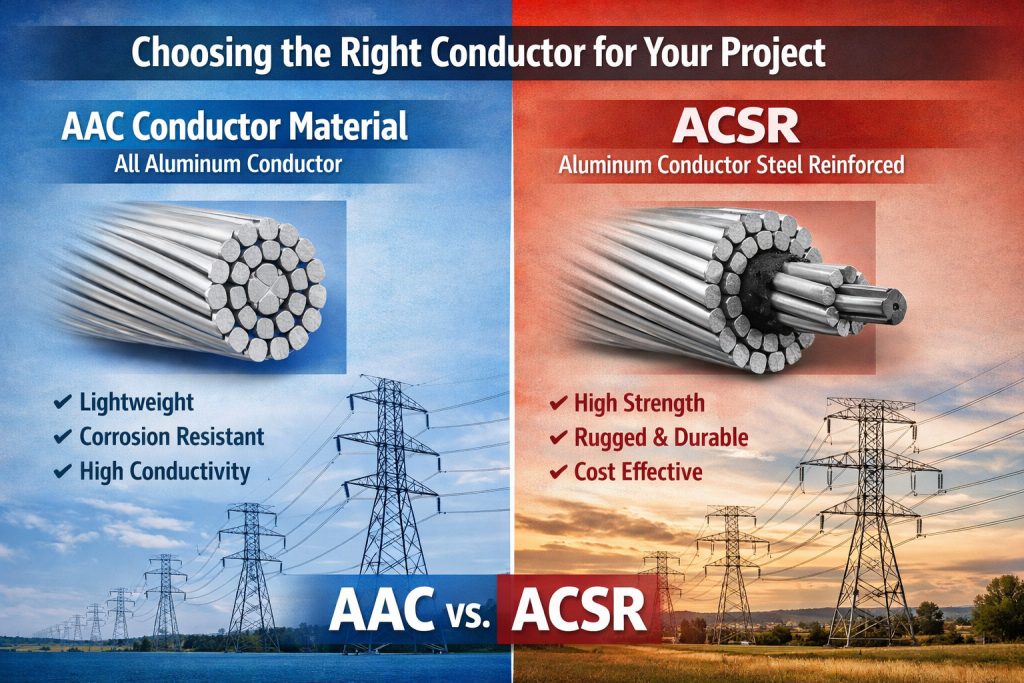
AAC (All Aluminum Conductor) is composed entirely of high-purity aluminum strands. It is designed primarily for low to medium voltage overhead power distribution lines. Its lightweight nature and excellent electrical conductivity make it a preferred choice in urban and rural distribution networks.
Key Properties of AAC
- Electrical Conductivity: AAC conductors offer high conductivity, ensuring minimal power loss over distribution lines. The conductivity depends on the aluminum grade, typically 135–150 ACSR units per meter for standard AAC types.
- Tensile Strength: AAC conductors have moderate tensile strength, sufficient for short spans and low-tension applications. Tensile strength varies from 70–120 MPa depending on aluminum purity.
- Corrosion Resistance: Pure aluminum provides natural resistance to corrosion, making AAC suitable for coastal and urban areas where pollution or humidity is a factor.
- Weight and Installation: Being lightweight, AAC conductors are easier to transport, handle, and install, reducing labor costs and installation time.
Grades and Standards
AAC conductors comply with IEC 61089 and ASTM B230/B231 standards. These standards specify mechanical, electrical, and dimensional characteristics for high-quality aluminum conductors. Using certified materials ensures compliance with utility safety and reliability requirements.
Typical Applications
- Low-voltage distribution lines in cities and towns
- Rural electrification projects
- Short-span overhead lines in industrial parks
3. What is ACSR Conductor Material?
Definition and Overview
ACSR (Aluminum Conductor Steel Reinforced) consists of a core of high-strength galvanized steel strands surrounded by layers of high-purity aluminum. The steel core provides mechanical strength, while the aluminum layers carry electrical current.
Construction and Material Composition
- Steel Core: The steel core enhances tensile strength, enabling longer spans between poles or towers.
- Aluminum Stranding: Aluminum layers provide high electrical conductivity for power transmission.
- Overall Design: The combination of aluminum and steel creates a balance between mechanical strength and conductivity, making ACSR suitable for high-voltage transmission lines.
Key Advantages
- High Tensile Strength: Steel reinforcement allows for long-distance transmission without sagging.
- Durability: Resistant to wind and ice loading, ideal for exposed environments.
- Electrical Efficiency: Provides good conductivity for high-load transmission lines.
Typical Applications
- High-voltage transmission lines across long distances
- Industrial and utility power grids requiring long-span lines
- Overhead lines in harsh environmental conditions
4. AAC Conductor vs ACSR: Key Differences
Understanding the differences between AAC and ACSR conductors helps engineers and project planners make informed decisions.
| Feature | AAC Conductor Material | ACSR Conductor Material |
|---|---|---|
| Material Composition | 100% pure aluminum | Aluminum with galvanized steel core |
| Electrical Conductivity | Very high | Moderate (slightly lower due to steel core) |
| Tensile Strength | Moderate | High |
| Weight | Lightweight | Heavier |
| Installation | Easier to handle and install | Requires careful handling due to weight |
| Cost | Lower | Higher due to steel core and manufacturing complexity |
| Applications | Low-voltage distribution, short spans | High-voltage transmission, long spans |
| Corrosion Resistance | Excellent | Good (steel core requires galvanization) |
Key Takeaways:
- AAC is ideal for low-tension, short-span applications, where weight and cost are critical.
- ACSR is better for high-tension, long-span lines, where mechanical strength is crucial.
5. Applications and Use Cases
AAC Conductor Applications
- Urban Distribution Networks: Lightweight and easy installation suits densely populated areas.
- Rural Electrification: Provides cost-effective solutions for low-voltage power lines.
- Industrial Parks: Suitable for short-range internal distribution.
Case Study Example:
A utility company in Bangladesh replaced aging copper distribution lines with AAC conductors, reducing installation costs by 20% while maintaining conductivity and reliability for low-voltage residential networks.
ACSR Conductor Applications
- High-Voltage Transmission: Steel core provides the strength needed for spans over 500 meters.
- Long-Distance Transmission Lines: Ideal for connecting power stations to substations across varied terrains.
- Extreme Environmental Conditions: Resistant to ice, wind, and mechanical stress.
Case Study Example:
A regional power utility in Canada upgraded a 132 kV transmission line using ACSR conductors, enabling a 600-meter span between towers without additional support, improving line stability under ice-loading conditions.
6. Standards and Compliance Considerations
Selecting a conductor requires compliance with international and national standards. This ensures safety, reliability, and long-term performance.
Standards for AAC
- IEC 61089: Overhead conductors of aluminum and aluminum alloys
- ASTM B230/B231: Aluminum conductor specifications
- ISO 9001: Manufacturing quality standards
Standards for ACSR
- IEC 61089: Conductor design standards
- ASTM B232: Standard for ACSR
- ISO certification for steel and aluminum quality
Note: Following these standards guarantees that conductors meet electrical, mechanical, and environmental requirements.
7. How to Choose the Right Conductor for Your Project
Several factors influence the choice between AAC and ACSR conductors:
- Voltage and Current Requirements:
- Low-voltage distribution → AAC
- High-voltage transmission → ACSR
- Span Length:
- Short spans (<300m) → AAC
- Long spans (>500m) → ACSR
- Mechanical Load & Environmental Conditions:
- Urban or coastal areas with minimal mechanical load → AAC
- Areas with ice, wind, or heavy mechanical stress → ACSR
- Cost and Maintenance Considerations:
- AAC: Lower cost, easier installation, minimal maintenance
- ACSR: Higher initial cost, requires handling expertise, but durable for long-term transmission
- Project Case Studies:
- Distribution Project Example: A utility in India installed AAC conductors for a rural electrification project, balancing cost and conductivity.
- Transmission Project Example: A utility in Europe deployed ACSR conductors for a 220 kV high-voltage line, ensuring structural stability over 700-meter spans.
FAQS
1. AAC Conductor Material: What is it and where is it used?
AAC conductor material, or All Aluminum Conductor, is made entirely of high-purity aluminum strands. It is primarily used in low-voltage distribution lines, urban electrification projects, and rural power networks. Its lightweight design and excellent electrical conductivity make it ideal for short-span overhead lines where tensile strength requirements are moderate.
2. AAC Conductor Material: How does it compare with ACSR?
AAC conductor material is fully aluminum, providing high conductivity but moderate mechanical strength, while ACSR combines aluminum and steel, offering high tensile strength for long-span, high-voltage lines. Choosing between AAC and ACSR depends on the project’s voltage, span length, and environmental conditions.
3. AAC Conductor Material: What are the key electrical properties?
The electrical properties of AAC conductor material include high conductivity, low resistance, and minimal power loss. These properties ensure efficient energy transmission over short distances. Conductivity is influenced by aluminum grade and strand design, adhering to standards like IEC 61089.
4. AAC Conductor Material: What are the mechanical properties?
AAC conductor material has moderate tensile strength and flexibility. Its lightweight aluminum composition allows easy installation, but it is less suitable for long-span, high-tension applications compared to ACSR. Proper design ensures reliable performance under typical mechanical loads.
5. AAC Conductor Material: How is it installed on distribution lines?
Installation of AAC conductor material involves standard stringing, tensioning, and support practices. Its lightweight nature reduces labor costs and simplifies handling, making it ideal for urban and rural distribution networks with short to medium spans.
6. AAC Conductor Material: What grades and standards does it follow?
AAC conductor material is manufactured to meet IEC 61089 and ASTM B230/B231 standards. These standards define aluminum purity, mechanical strength, and electrical conductivity. Compliance ensures reliable performance and safety in electrical transmission projects.
7. AAC Conductor Material: How does it resist corrosion?
Pure aluminum in AAC conductor material naturally forms an oxide layer that protects against corrosion. This makes it suitable for environments such as urban areas and coastal regions, where humidity or pollution could affect less resistant conductors.
8. AAC Conductor Material: What are the cost considerations?
AAC conductor material is generally more cost-effective than ACSR due to simpler construction and lightweight aluminum strands. It reduces installation costs, transport expenses, and maintenance requirements for low-voltage distribution lines.
9. AAC Conductor Material: Which projects benefit most from it?
Projects that require short-span, low-voltage distribution networks such as urban electrification, rural villages, and industrial parks benefit most from AAC conductor material. It provides high conductivity, reliable performance, and reduced handling complexity.
10. AAC Conductor Material: How to choose the right type for your project?
Selecting the appropriate AAC conductor material depends on factors such as voltage, span length, environmental conditions, and mechanical load. Engineers should compare aluminum grades, tensile strength, and conductivity to ensure the conductor meets project specifications and standards.
Conclusion
Choosing between AAC conductor material and ACSR conductors is not a one-size-fits-all decision. Each conductor type has its strengths and is suitable for specific project requirements.
- Use AAC conductor material for short-span, low-voltage distribution networks, urban or rural electrification projects where weight and cost are critical.
- Use ACSR conductor material for high-voltage, long-span transmission lines, industrial projects, and areas subject to mechanical stress or harsh environmental conditions.
By understanding material properties, standards, applications, and real-world use cases, engineers, utilities, and EPC contractors can make informed choices that ensure reliability, efficiency, and cost-effectiveness in their power projects.
For high-quality AAC and ACSR conductors, HNBF Power provides certified, durable, and globally trusted solutions, supporting utilities and industrial clients worldwide.