

Triplex Cable for Low Voltage Power Distribution Systems is a widely used solution in modern electrical distribution networks, designed to deliver safe, stable, and efficient power from distribution transformers to end users. It consists of two insulated phase conductors and one neutral messenger conductor, typically made of aluminum, twisted together to form a compact overhead cable system. This design enhances mechanical strength while reducing electrical risks associated with exposed conductors.
In today’s power infrastructure, utilities and EPC contractors are increasingly adopting triplex cables due to their improved safety performance, reduced power losses, and ability to withstand harsh environmental conditions such as wind, rain, and temperature variations. Unlike traditional bare conductor systems, triplex cables minimize the risk of accidental contact, power theft, and line faults, making them ideal for residential, commercial, and rural electrification projects.
With the growing demand for reliable and cost-effective electricity distribution, triplex cable systems have become an essential part of low voltage networks worldwide.
Triplex Cable for Low Voltage Power Distribution Systems: Design, Applications, and Utility Benefits
In this guide we will explain Triplex Cable for Low Voltage Power Distribution Systems in detail, covering its design, applications, specifications, and utility benefits.
Triplex Cable for Low Voltage Power Distribution Systems is one of the most widely used solutions in modern electrical infrastructure, especially for residential, commercial, and rural electrification networks. It plays a critical role in ensuring safe, efficient, and cost-effective electricity delivery from distribution transformers to end users.
In today’s utility sector, where grid reliability, safety, and loss reduction are key priorities, triplex cables have become a preferred choice over traditional bare conductor systems. This article provides a complete technical and commercial guide covering the design, specifications, applications, installation, standards, and utility benefits of triplex cable systems.
1. Introduction to Triplex Cable for Low Voltage Power Distribution Systems
Triplex Cable for Low Voltage Power Distribution Systems refers to a type of overhead power cable consisting of three conductors twisted together:
- Two insulated phase conductors
- One neutral messenger conductor (bare or insulated depending on design)
This configuration is primarily used for low voltage (LV) overhead distribution networks, typically ranging from 230V to 1kV systems.
Why utilities use triplex cable:
- Reduces electrical accidents caused by exposed conductors
- Improves reliability in distribution networks
- Reduces power theft and illegal tapping
- Enhances performance in harsh environmental conditions
Triplex cables are widely used in residential power supply lines, rural electrification projects, and last-mile utility connections.
2. Triplex Cable Design and Construction
The design of triplex cable is engineered for mechanical strength, electrical efficiency, and environmental resistance.
2.1 Conductor Arrangement
Triplex cable consists of:
- Phase conductors (2 cores): Aluminum or aluminum alloy
- Neutral conductor (1 core): Bare aluminum or insulated messenger wire
The conductors are helically twisted to maintain mechanical balance and flexibility.
2.2 Insulation System
Most modern triplex cables use:
- Cross-linked polyethylene (XLPE)
- High-density polyethylene (HDPE)
These materials provide:
- UV resistance
- Moisture protection
- High dielectric strength
- Long service life (typically 25–40 years)
2.3 Mechanical Structure
- Central neutral conductor carries tensile load
- Phase conductors are supported around neutral
- Designed to withstand wind load, ice load, and tension stress
This makes triplex cable ideal for overhead installation in variable weather conditions.
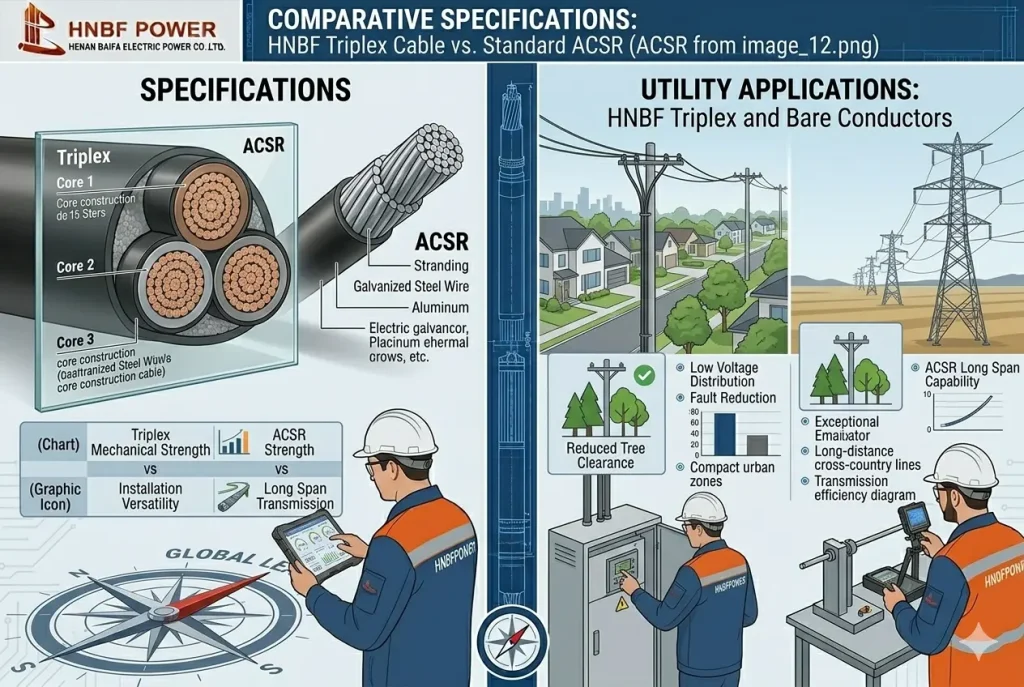
3. Electrical and Technical Specifications
Triplex Cable for Low Voltage Power Distribution Systems is designed according to international utility standards such as IEC and ASTM.
Key specifications include:
Voltage Rating
- 0.6/1 kV typical low voltage rating
Current Carrying Capacity (Ampacity)
- Depends on conductor size (16 mm² to 150 mm² commonly used)
- Higher cross-section = higher load capacity
Insulation Resistance
- High resistance to leakage current under wet conditions
Temperature Range
- Operating: -20°C to +90°C (typical XLPE design)
Standards Compliance
- IEC 60502
- ASTM B231 / B232 (aluminum conductors)
These specifications ensure safe integration into national grid systems.
4. Working Principle in Low Voltage Distribution Systems
Triplex cables operate in overhead distribution networks as the final link between transformers and consumers.
How it works:
- Electricity is stepped down at distribution transformer
- Power is transmitted via triplex cable along poles
- Neutral conductor stabilizes the system voltage
- Insulated phase conductors deliver electricity safely to users
Key functional advantage:
Because conductors are insulated and bundled together, the risk of short circuits caused by tree contact, wind, or external objects is significantly reduced.
5. Applications of Triplex Cable in Power Distribution Systems
Triplex Cable for Low Voltage Power Distribution Systems is used in multiple infrastructure segments:
5.1 Residential Power Supply
- Individual house connections
- Apartment complexes
- Housing societies
5.2 Rural Electrification Projects
- Village electrification networks
- Agricultural pump connections
- Remote area power supply systems
5.3 Urban Distribution Networks
- Street lighting systems
- Small commercial load distribution
- Municipal grid extensions
5.4 Industrial and Commercial Use
- Workshops
- Warehouses
- Small manufacturing units
Its versatility makes it suitable for both developing and developed grid systems.
6. Benefits of Triplex Cable for Utility and EPC Projects
Triplex cables offer significant operational and financial advantages for utilities and EPC contractors.
6.1 Improved Safety
Insulated conductors reduce:
- Electrical shock risks
- Accidental contact hazards
- Short circuit incidents
6.2 Reduced Power Theft
Bundled construction makes illegal tapping difficult, improving revenue protection for utilities.
6.3 Lower Transmission Losses
Optimized conductor arrangement reduces:
- Line impedance
- Voltage drop
- Energy losses in distribution
6.4 Reduced Maintenance Cost
Compared to bare conductor systems:
- Fewer breakdowns
- Less vegetation-related faults
- Lower inspection frequency
6.5 Faster Installation
Triplex cable systems are easier to install on utility poles, reducing labor and project time.
7. Triplex Cable vs Bare Conductor Systems
A key decision for utilities is choosing between triplex cable and traditional bare conductors.
Safety
- Triplex cable: High safety due to insulation
- Bare conductor: Higher risk of contact and accidents
Installation
- Triplex cable: Simple, bundled installation
- Bare conductor: Requires precise spacing and hardware
Performance
- Triplex cable: Better in urban and tree-dense areas
- Bare conductor: Better for high-voltage long-distance transmission
Cost Efficiency
While triplex cable has slightly higher material cost, it reduces long-term maintenance and outage costs.
8. Installation Guidelines for Triplex Cable Systems
Proper installation ensures long service life and reliability.
Key steps:
- Mounted on utility poles with standard clamps
- Maintain correct sag and tension balance
- Ensure proper insulation clearance
- Avoid sharp bending during installation
Safety practices:
- De-energize lines during installation
- Use insulated tools
- Follow utility safety regulations
Proper installation reduces system failures and improves cable lifespan.
9. Standards and Compliance
Triplex cables are manufactured under strict international standards:
Electrical standards:
- IEC 60502 (power cables)
- IEC 60228 (conductors)
Mechanical standards:
- ASTM B231 (aluminum conductors)
- ASTM B232 (AAC conductors)
Quality tests include:
- Tensile strength test
- Voltage withstand test
- Insulation resistance test
- Aging and UV resistance test
Compliance ensures global usability in utility projects.
10. Why Utilities Prefer Triplex Cable
Utilities increasingly prefer Triplex Cable for Low Voltage Power Distribution Systems because it aligns with modern grid requirements:
Key reasons:
- High operational reliability
- Reduced outage frequency
- Improved safety compliance
- Lower lifecycle cost
- Compatibility with smart grid expansion
In modern electrification projects, utilities prioritize long-term efficiency over short-term cost savings.

11. HNBF Power Manufacturing Capability
Manufacturers like HNBF Power play an important role in supplying high-quality triplex cables for global infrastructure projects.
HNBF Power focuses on:
- Aluminum conductor manufacturing
- Overhead distribution cable systems
- Custom triplex cable specifications
- Export-grade utility solutions
Their products are widely used in EPC and utility-scale electrification projects across multiple regions.
12. Case Study: Rural Electrification Efficiency Improvement
A utility distribution project in a developing region replaced bare conductor lines with triplex cable systems for last-mile connectivity.
Results observed:
- 32% reduction in line faults
- 45% decrease in maintenance interventions
- Significant reduction in illegal tapping incidents
- Improved voltage stability at consumer end
This demonstrates how triplex cable improves both technical and economic performance in real-world utility systems.
13. Future of Triplex Cable in Power Distribution Systems
The future of low voltage distribution is shifting toward:
- Insulated overhead systems
- Smart grid integration
- Loss reduction technologies
- Safer urban electrification networks
Triplex cables will continue to play a major role due to:
- Scalability
- Cost efficiency
- Safety improvements
- Compatibility with modern infrastructure
FAQs – Triplex Cable for Low Voltage Power Distribution Systems
1. What is Triplex Cable for Low Voltage Power Distribution Systems?
Triplex Cable for Low Voltage Power Distribution Systems is an overhead bundled cable used to deliver electricity at low voltage levels, typically 230V to 1kV. It consists of two insulated phase conductors and one neutral conductor twisted together for safe and efficient power distribution.
2. Where is triplex cable commonly used?
It is commonly used in residential power supply, rural electrification projects, street lighting systems, and low voltage overhead distribution networks in urban and semi-urban areas.
3. What is the main advantage of triplex cable over bare conductor systems?
The main advantage is safety. Triplex cable uses insulated conductors, which reduces the risk of electric shock, short circuits, and accidental contact compared to bare conductor systems.
4. What materials are used in triplex cable?
Triplex cables typically use aluminum conductors with XLPE (cross-linked polyethylene) or HDPE insulation materials, which provide durability, weather resistance, and electrical insulation.
5. What is the voltage rating of triplex cable?
Most triplex cables are designed for low voltage systems with a standard rating of 0.6/1 kV, suitable for distribution networks.
6. How does triplex cable reduce power theft?
Because the conductors are insulated and bundled together, it becomes difficult to tap electricity illegally without detection, reducing power theft in distribution systems.
7. Is triplex cable suitable for rural electrification?
Yes, triplex cable is widely used in rural electrification due to its safety, low maintenance requirements, and ability to perform well in outdoor overhead conditions.
8. What standards does triplex cable follow?
Triplex cables are generally manufactured according to international standards such as IEC 60502 and ASTM specifications for conductors and insulation performance.
9. What is the lifespan of triplex cable?
With proper installation and environmental conditions, triplex cables can last between 25 to 40 years due to their UV-resistant insulation and durable construction.
10. Why do utilities prefer triplex cable in modern distribution systems?
Utilities prefer triplex cable because it improves safety, reduces maintenance costs, minimizes power losses, and provides reliable performance in low voltage power distribution systems.
Summary
Triplex Cable for Low Voltage Power Distribution Systems is a critical component of modern electrical infrastructure. Its intelligent design, strong insulation system, and efficient performance make it ideal for residential, rural, and urban power distribution networks.
With increasing demand for safe and reliable electricity, utilities and EPC contractors are rapidly adopting triplex cable systems as a standard solution.
For manufacturers like HNBF Power, this represents a strong growth opportunity in global power infrastructure development.