

Overhead Service Conductor plays a crucial role in modern utility power distribution systems, connecting the main distribution network to residential, commercial, and industrial end users. Unlike high-voltage transmission lines, service conductors are designed to deliver electricity safely and efficiently over shorter distances while meeting stringent electrical and mechanical standards.
Selecting the right type of overhead service conductor is critical to ensure reliability, minimize line losses, and maintain compliance with international standards such as IEC, ANSI, and IEEE.
These conductors come in various materials, including AAC (All Aluminum Conductor), AAAC (All Aluminum Alloy Conductor), and ACSR (Aluminum Conductor Steel Reinforced), each offering unique properties to suit different project requirements. Factors such as load capacity, environmental conditions, span length, and installation standards influence the choice of conductor for a particular utility project.
Proper understanding of specifications, materials, and installation practices is essential for engineers, EPC contractors, and utility operators aiming for long-lasting performance and operational safety.
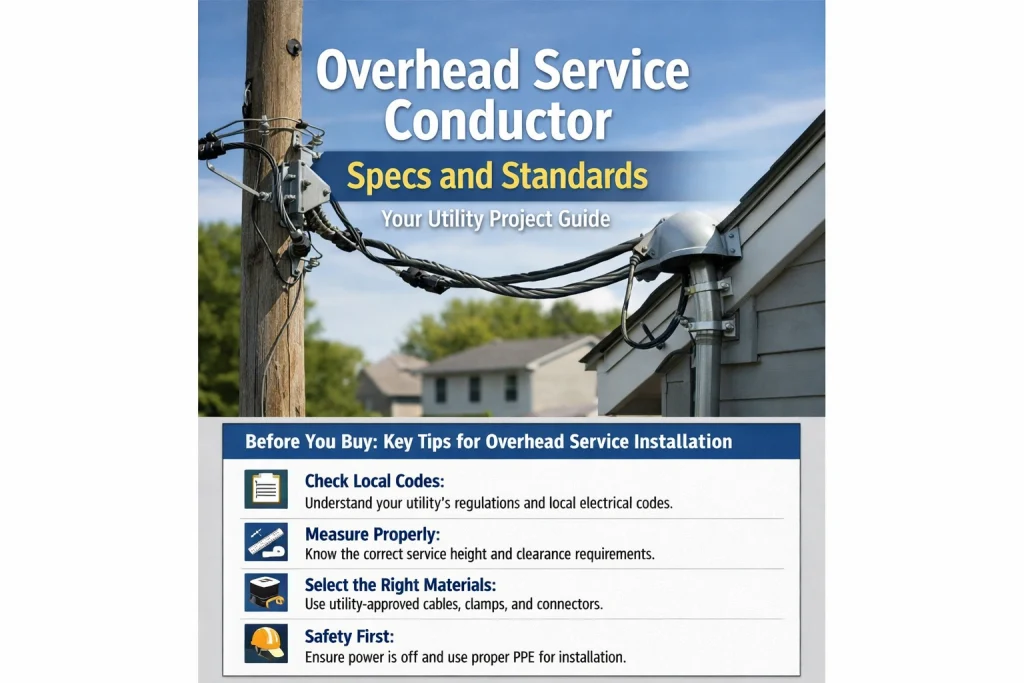
Overhead Service Conductor Specs and Standards: Your Utility Project Guide
In this guide, we will explain all the critical specifications, standards, types, applications, and best practices for overhead service conductors to help you make informed decisions for your utility projects.
Introduction to Overhead Service Conductors
Overhead service conductors are a critical component of utility power distribution systems. Unlike main transmission conductors, service conductors are used to connect the distribution network to residential, commercial, and industrial customers. Their proper selection and installation are essential to ensure reliable power delivery, minimize line losses, and comply with safety standards.
In utility projects, overhead service conductors bridge the gap between high-voltage distribution lines and end-user connections. They must maintain structural integrity under varying weather conditions, sustain the required electrical load, and adhere to recognized international and regional standards.
HNBF Power manufactures a wide range of overhead service conductors, including AAC (All Aluminum Conductor), AAAC (All Aluminum Alloy Conductor), and ACSR (Aluminum Conductor Steel Reinforced), catering to global utility and EPC projects.
Types of Overhead Service Conductors
AAC (All Aluminum Conductor)
AAC conductors are composed entirely of aluminum and are widely used in low to medium voltage distribution networks. Their high conductivity, lightweight design, and corrosion resistance make them ideal for residential and commercial service lines. AAC conductors provide excellent electrical performance but have lower tensile strength compared to reinforced options, making them suitable for short-span installations.
Applications:
- Residential service lines
- Low-voltage commercial connections
- Short overhead spans
AAAC (All Aluminum Alloy Conductor)
AAAC conductors are made from aluminum alloys, offering higher tensile strength than AAC while maintaining good conductivity. These conductors are suitable for longer spans and areas prone to high winds or heavy ice loading. Their improved mechanical properties reduce sag and allow for safer, more efficient installations.
Applications:
- Long-span residential and commercial service lines
- Areas with extreme weather conditions
- Distribution networks requiring higher mechanical strength
ACSR (Aluminum Conductor Steel Reinforced)
ACSR conductors combine aluminum for conductivity with a steel core for mechanical support. This combination provides high tensile strength and moderate weight, making ACSR conductors suitable for medium-voltage service lines and industrial applications. They are often chosen for areas with heavy loads or challenging environmental conditions.
Applications:
- Industrial service connections
- Medium-voltage overhead lines
- Utility networks in high-load areas
Copper Overhead Service Conductors
Copper conductors are less common for overhead service lines due to their higher cost but are sometimes used in specialized applications where superior conductivity and minimal line losses are required.

Material & Electrical Specifications
Conductor Ampacity and Current-Carrying Capacity
Ampacity refers to the maximum current a conductor can carry without exceeding its temperature rating. Overhead service conductors must meet the current demands of the connected load while complying with utility regulations.
- AAC: Suitable for low-current residential service lines
- AAAC: Handles higher currents over longer spans
- ACSR: Supports industrial and medium-voltage loads
Accurate ampacity calculations are crucial to prevent overheating, energy loss, and equipment damage.
Cross-Section and Conductor Size Selection
Conductor size is determined by the load, voltage, span length, and environmental factors. Common sizes for overhead service conductors range from 16 mm² to 95 mm², depending on application requirements. Choosing the correct cross-section ensures minimal voltage drop and optimal energy efficiency.
Tensile Strength and Mechanical Properties
Mechanical strength is critical for overhead service conductors to resist wind, ice, and environmental stress. AAC conductors provide moderate tensile strength, AAAC offers higher mechanical support, and ACSR provides maximum tensile strength with the steel core.
Electrical Conductivity and Line Efficiency
Aluminum and aluminum alloy conductors offer high conductivity relative to their weight, making them cost-effective for overhead applications. Line efficiency is directly impacted by conductor material, cross-section, and installation quality.
Standards and Compliance for Overhead Service Conductors
IEC, ANSI, and IEEE Standards
Overhead service conductors must comply with internationally recognized standards:
- IEC 60228: Conductors of insulated cables
- ANSI C119: Aluminum and copper conductors for overhead lines
- IEEE 738: Calculation of ampacity of overhead conductors
Compliance ensures that conductors perform reliably under expected electrical and environmental conditions.
Insulation, Weather Resistance, and Durability Requirements
Although most service conductors are bare, some applications may require insulated service conductors for safety. Conductors must withstand:
- UV exposure
- Temperature fluctuations
- Ice and wind loading
- Corrosion from industrial or coastal environments
Safety Guidelines for Overhead Line Installation
- Maintain safe clearances from structures and vegetation
- Use appropriate hardware for pole attachment
- Follow grounding and earthing practices
- Inspect conductors regularly to identify wear or damage
Applications of Overhead Service Conductors
Overhead service conductors are used in a variety of settings depending on the type of conductor selected:
- Residential Service Lines: AAC conductors are common for short-span home connections.
- Commercial and Industrial Power Connections: AAAC and ACSR conductors provide enhanced strength and reliability.
- Utility Distribution Networks: Overhead service conductors connect medium-voltage lines to low-voltage customer connections.
- Low-Voltage vs Medium-Voltage Service Applications: Proper selection ensures minimal line loss and safety compliance.
Installation and Maintenance Best Practices
Pole Mounting and Conductor Sag Considerations
Correct installation involves maintaining proper tension and sag for the conductor, preventing line snapping or excessive droop. Sag depends on:
- Conductor type
- Span length
- Temperature and environmental factors
Conductor Tension and Support Techniques
Tension must be adjusted to maintain structural integrity without exceeding the conductor’s tensile rating. Use reinforced hardware where needed.
Maintenance Tips to Maximize Conductor Lifespan
- Regular inspection for corrosion or wear
- Clean hardware and poles to prevent electrical leakage
- Replace damaged or sagging sections promptly
Troubleshooting Common Issues
- Excessive sag due to thermal expansion
- Mechanical damage from storms or tree contact
- Overheating due to overcurrent or insufficient cross-section
Choosing the Right Overhead Service Conductor for Your Project
Key Factors in Selection
- Load requirements: Residential, commercial, or industrial
- Span length: Short spans vs long spans
- Environmental conditions: Coastal, icy, or high-wind areas
- Voltage and current: Low-voltage vs medium-voltage networks
HNBF Power’s Solutions
HNBF Power manufactures high-quality AAC, AAAC, and ACSR overhead service conductors that meet international standards. Our products are designed to:
- Withstand environmental stress
- Ensure reliable current flow
- Reduce line losses
- Facilitate easy installation for utilities and EPC contractors
Procurement and Supplier Selection
When selecting a supplier, consider:
- Manufacturing certifications (ISO, CE, CCC)
- Experience in global utility projects
- Availability of technical support and documentation
- Product range and customization options
FAQs About Overhead Service Conductors
Q1: What is the difference between AAC, AAAC, and ACSR?
- AAC: All aluminum, suitable for residential low-voltage service lines.
- AAAC: Aluminum alloy, higher tensile strength, long-span applications.
- ACSR: Aluminum conductor with steel core, ideal for industrial and medium-voltage service lines.
Q2: How do I calculate conductor ampacity for service lines?
- Ampacity depends on conductor material, cross-section, temperature rating, and voltage drop requirements. Refer to IEC, ANSI, or IEEE standards for accurate calculations.
Q3: What is the expected lifespan of overhead service conductors?
- AAC: 25–30 years under standard conditions
- AAAC: 30–40 years depending on environment
- ACSR: 35–50 years with proper maintenance
Q4: Can overhead service conductors be used for industrial applications?
- Yes, AAAC and ACSR conductors are designed for industrial overhead service lines that require higher mechanical strength.
Q5: What factors should be considered when selecting a service conductor?
- Load requirements, span length, voltage level, environmental conditions, and installation standards are critical factors for proper conductor selection.
Q6: Are service conductors insulated or bare?
- Most overhead service conductors are bare aluminum or aluminum alloy, but some residential or commercial applications may use insulated conductors for safety and regulatory compliance.
Q7: What are the common applications of overhead service conductors?
- Residential service lines, commercial power connections, low- and medium-voltage industrial networks, and utility distribution systems.
Q8: How does environmental exposure affect service conductors?
- Conductors must withstand UV radiation, temperature fluctuations, ice, wind loading, and corrosion, especially in coastal or industrial regions. AAAC and ACSR offer enhanced durability in harsh conditions.
Q9: How should service conductors be maintained to maximize lifespan?
- Conduct regular inspections for corrosion, sag, and mechanical damage. Ensure proper tension, replace damaged sections promptly, and maintain hardware for long-term performance.
Q10: Where can I source high-quality overhead service conductors for my utility project?
- Manufacturers like HNBF Power offer AAC, AAAC, and ACSR overhead service conductors that comply with IEC, ANSI, and IEEE standards, suitable for residential, commercial, and industrial applications globally.
Summary
Overhead service conductors are a vital part of any utility or EPC project. Selecting the correct type, size, and material ensures reliable power distribution, safety compliance, and long-term performance. HNBF Power provides AAC, AAAC, and ACSR conductors that meet international standards, offering robust solutions for residential, commercial, and industrial networks.
Proper understanding of conductor specifications, installation techniques, and maintenance practices will maximize network efficiency and prevent costly downtime. For reliable, high-quality overhead service conductors, choosing a manufacturer like HNBF Power ensures your utility projects are completed efficiently and safely.