

ACSR Conductor Manufacturing Process is a precise and highly controlled engineering workflow that combines the strength of steel with the conductivity of aluminum to produce reliable transmission conductors. These conductors are essential for high-voltage overhead power lines, ensuring efficient electricity transmission across long distances. At HNBFpower, the manufacturing process follows strict international standards such as ASTM, IEC, and BS, ensuring that each conductor meets rigorous mechanical and electrical performance benchmarks.
The process begins with careful selection and preparation of raw materials aluminum rods and steel wires followed by a sequence of drawing, stranding, and testing operations. Every stage, from steel wire production to quality control and final packaging, is optimized for consistency, durability, and performance. With years of expertise in conductor manufacturing, HNBFpower integrates advanced production technologies and inspection systems to guarantee that each ACSR conductor can withstand the demands of modern transmission networks.
ACSR Conductor Manufacturing Process Explained | HNBFpower Production Guide
In this guide, we will explain the complete ACSR conductor manufacturing process step by step.
The Aluminum Conductor Steel Reinforced (ACSR) is one of the most widely used conductors for overhead power transmission and distribution lines. Known for its strength, durability, and high conductivity, ACSR combines aluminum’s conductivity with the steel core’s tensile strength making it ideal for long-span power lines.
At HNBFpower, the ACSR conductor manufacturing process follows strict international standards such as ASTM, IEC, and BS, ensuring consistent quality and performance across every meter of conductor produced. This guide explains each stage of the ACSR conductor manufacturing process from raw material preparation to final shipment giving readers a transparent view of how reliable transmission conductors are made.
Raw Material Preparation
The foundation of every high-quality ACSR conductor lies in the quality of its raw materials. The process starts with selecting and preparing aluminum rods and steel wires, both of which play distinct roles in the final conductor design.
1. Material Selection
- Aluminum: Hard-drawn aluminum wires (typically 1350-H19 grade) are chosen for their lightweight and high electrical conductivity.
- Steel: Galvanized or aluminum-clad steel wire (Grade A, B, or C) is used as the core, providing tensile strength to withstand mechanical loads.
2. Material Inspection
Every incoming batch undergoes rigorous quality checks before entering production:
- Tensile strength testing ensures mechanical reliability.
- Chemical composition analysis guarantees purity and compliance with HNBFpower’s quality standards.
- Surface inspection eliminates rods or wires with oxidation, dents, or uneven coating.
3. Preparation for Drawing
Before wire drawing, aluminum rods are cleaned and lubricated to ensure smooth drawing through dies, while steel wires are descaled and coated to improve corrosion resistance.

2. Steel Wire Production
The steel core acts as the backbone of the ACSR conductor. HNBFpower focuses on precise processing and coating to ensure maximum durability and performance in field conditions.
1. Wire Drawing
Steel rods are drawn through a series of dies to achieve the required diameter.
- Multiple-die drawing machines are used for gradual reduction without compromising tensile strength.
- Cooling and lubrication systems maintain uniform surface finish and reduce friction during drawing.
2. Annealing Process
After drawing, the steel wire may undergo controlled heat treatment (annealing) to relieve internal stresses and achieve optimal ductility.
3. Galvanizing or Aluminum-Cladding
To protect the steel core from corrosion:
- Galvanizing: The drawn wire is passed through a zinc bath under controlled temperature, ensuring a uniform coating.
- Aluminum-cladding: In some high-corrosion environments, aluminum-coated steel (ACS) is preferred for extended service life.
4. Quality Testing
Before stranding, the steel wire undergoes:
- Coating thickness inspection
- Torsion and bend tests
- Tensile strength verification
This ensures the steel core meets the mechanical requirements for ACSR conductors.
3. Aluminum Wire Production
The aluminum strands are responsible for carrying electrical current efficiently.
1. Rod Breakdown and Drawing
- Large aluminum rods (9.5mm diameter) are drawn into smaller wires using rod breakdown machines.
- The process is continuous and monitored for diameter accuracy and surface smoothness.
2. Annealing
In some cases, controlled annealing softens the wires to enhance flexibility during stranding. However, most ACSR conductors use hard-drawn aluminum to maintain tensile strength.
3. Surface Treatment and Inspection
Before stranding:
- Aluminum wires are cleaned to remove any drawing lubricants or residues.
- Eddy current testing is used to detect surface flaws or internal cracks.
- Dimensional checks confirm wire diameter uniformity across the batch.
4. Stranding Process
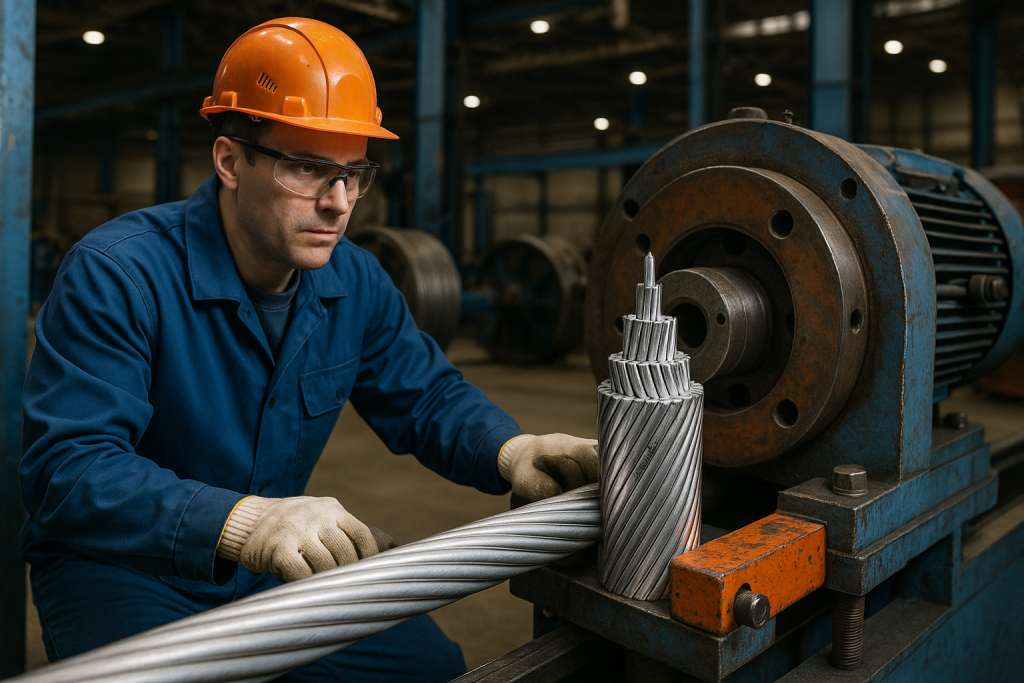
This stage brings together the steel and aluminum components to form the final ACSR conductor. It’s a precise process that defines the conductor’s mechanical and electrical characteristics.
1. Core Stranding (Steel Wires)
- The steel wires are stranded first, forming the central core.
- Depending on conductor type, the core can be single wire or multiple layers in concentric lay.
- Automatic stranding machines ensure consistent tension and lay ratio for accurate geometry.
2. Aluminum Stranding
- Aluminum wires are stranded around the steel core in multiple layers.
- The lay direction alternates between layers (right-hand and left-hand) for balanced torque.
- Machines maintain precise tension to prevent wire elongation or surface damage.
3. Lubrication and Cooling
To minimize friction during stranding:
- A controlled amount of lubricant is applied to improve strand compactness.
- Cooling fans ensure temperature stability, preventing material stress or deformation.
4. Conductor Compaction
In some designs, compacted ACSR conductors are produced using rollers to reduce overall diameter and improve surface smoothness, providing better corona performance for high-voltage lines.
5. Quality Control
At HNBFpower, quality control is integrated into every phase of the ACSR conductor manufacturing process. Each conductor undergoes stringent inspection before approval for shipment.
1. Dimensional and Visual Inspection
- Verify overall diameter, roundness, and lay length using precision instruments.
- Check surface finish for defects, scratches, or strand overlaps.
2. Mechanical Testing
- Tensile test: Confirms conductor strength meets or exceeds design specifications.
- Elongation test: Measures ductility under load.
- Stress-strain analysis: Determines elastic modulus for mechanical modeling.
3. Electrical Testing
- DC resistance test: Ensures aluminum strands meet conductivity requirements.
- AC resistance and temperature rise tests: Validate operational efficiency.
4. Corrosion and Coating Evaluation
For galvanized and aluminum-clad steel cores:
- Salt spray tests and immersion tests simulate long-term environmental exposure.
- Coating adhesion and thickness are verified to prevent premature corrosion.
5.Final Inspection and Certification
Once tests are passed:
- Each conductor coil is tagged with batch information, dimensions, and test results.
- Test reports and compliance certificates (ASTM B232, IEC 61089, etc.) are prepared.
6. Packaging and Shipment
The final stage ensures the conductor reaches clients safely and in perfect condition.
1. Coil Formation and Winding
Conductors are wound into coils or reels using automatic winding systems.
- Coil size depends on conductor diameter and customer requirements.
- Reels are made from treated wood or steel drums to prevent damage during transport.
2. Wrapping and Sealing
- Each coil is wrapped with moisture-resistant film and reinforced with steel strapping.
- Labels contain conductor type, size, weight, and batch number for traceability.
3. Storage and Handling
- Coils are stored in covered, ventilated areas to prevent moisture absorption.
- Forklifts and cranes with nylon slings are used for loading to avoid surface damage.
4. Global Shipment
HNBFpower exports ACSR conductors worldwide, following client-specific packaging standards.
- Custom marking and documentation support international logistics.
- The supply chain team ensures timely delivery while maintaining quality integrity.
Case Study: HNBFpower ACSR Conductor for Transmission Project
In a recent 132kV transmission project, HNBFpower supplied ACSR “Lynx” and “Moose” type conductors.
- Total length supplied: 120 km
- Average tensile strength: 135 kN
- Conductor diameter: 31.5 mm
- Standard compliance: ASTM B232
The project demonstrated:
- Excellent conductor sag control during installation.
- Minimal energy loss due to low DC resistance.
- Superior corrosion protection under coastal climate conditions.
This case underlines how the ACSR conductor manufacturing process at HNBFpower results in durable, reliable conductors capable of performing under demanding environmental and electrical conditions.
Where to Buy ACSR Conductors
If you’re seeking a trusted partner for high-quality ACSR conductors, HNBFpower offers a full range of solutions. From design customization to technical consultation, the company supports transmission line projects worldwide.
Visit HNBFpower.com to explore conductor specifications or request a quotation for your next transmission project.
Top 10 FAQs About ACSR Conductor Manufacturing
1. What does ACSR stand for?
ACSR stands for Aluminum Conductor Steel Reinforced, a type of stranded conductor used in overhead transmission and distribution lines.
2. Why is steel used in ACSR conductors?
Steel provides the mechanical strength needed to support long spans and heavy loads, while aluminum ensures efficient electrical conductivity.
3. What raw materials are used in ACSR manufacturing?
The main materials are hard-drawn aluminum wires (1350-H19 grade) and galvanized or aluminum-clad steel wires for the core.
4. How is the steel wire prepared for ACSR conductors?
Steel wires are drawn, annealed, and galvanized or aluminum-clad to achieve the required diameter, strength, and corrosion resistance.
5. What happens during the aluminum wire production stage?
Aluminum rods are drawn through dies to achieve precise diameters and may undergo surface cleaning and inspection before stranding.
6. How does the stranding process work in ACSR manufacturing?
Steel wires form the core, and aluminum wires are stranded concentrically around it. The alternating lay direction ensures balance and flexibility.
7. What quality tests are performed on ACSR conductors?
Tests include tensile strength, elongation, electrical resistance, corrosion, and dimensional inspection to ensure compliance with IEC and ASTM standards.
8. Why is galvanizing important in the steel core?
Galvanizing provides a protective zinc layer that prevents rust and extends the life of the conductor, especially in coastal or humid environments.
9. How are ACSR conductors packaged for shipment?
Conductors are wound on wooden or steel reels, wrapped with moisture-resistant film, labeled, and securely strapped for global shipment.
10. Where can I buy ACSR conductors?
You can buy certified ACSR conductors directly from HNBFpower – a trusted manufacturer offering high-quality power transmission products worldwide.
The ACSR conductor manufacturing process involves precision, control, and adherence to global standards. From raw material preparation to final inspection, every step defines the conductor’s strength, reliability, and performance.
At HNBFpower, continuous improvement, state-of-the-art production lines, and strict quality control ensure that every ACSR conductor delivers superior electrical and mechanical performance. For power utilities, EPC contractors, and distributors, choosing HNBFpower means investing in reliability that powers grids across the world.